Economic update April 2024: productivity in Australian business
12 April 2024

Key points
- There has been a decline in the proportion of businesses reporting productivity improvements over the last decade.
- This trend occurred across most industries and business sizes.
- Productivity improvements are more likely to occur in large businesses.
- Productivity outcomes differ across sectors.
Catch up: What is productivity growth?
In economics, productivity growth refers to improvements or increase in the efficiency of work or production, without a change in resources or output.
Productivity growth can result in better profit margins for business, and it can also help stimulate the jobs market. This means higher incomes and a better standard of living for people.
Recent updates
In September 2023, I released a report on productivity growth in Australia. This first report argued that the sharp drop in productivity growth over recent years was largely due to short-term issues associated with the pandemic.
In March this year, I released a second update, looking at the trending reduction in productivity growth, and how historically, productivity growth moves in ‘waves’ according to changes in technological progress.
Australia’s current view of productivity
Much of the debate surrounding productivity in Australia tends to focus on what changes the government can make to tax, their spending decisions, or regulations. Obviously, having the right fiscal and regulatory settings matter. But the actual productivity improvements come from decisions made by businesses (and governments, in their role of providing services such as education and health).
The ABS conducts an annual survey asking businesses a range of questions, including whether productivity has increased, decreased or stayed the same. The answers provide colour behind productivity trends, but can be misleading on growth rates. Productivity growth could slow even if a higher proportion of companies indicate increased productivity, as the increase could be lower than previous years.
With that as a caveat, around a quarter of businesses typically experience rising productivity, a quarter decreasing and about a third report unchanged productivity (the remaining firms report ‘don’t know,’ which is a bit of a worry). Throughout the 2010s, less businesses reported increased productivity, and there was a corresponding rise in the number reporting no changes. This outcome is consistent with ABS data that suggests productivity growth slowed over the course of that decade. This trending productivity decline was experienced across all business sizes, although it was a little later in the decade for larger firms.
The survey suggests that historically a higher proportion of large businesses experience productivity increases than small firms. This makes sense as larger businesses are more likely to have stronger cash flows, which would not only increase their chances of survival, but provide them with greater capacity to invest.
Larger businesses are also more likely to have the skilled staff necessary to find productivity improvements, as well as understand which investments are likely to provide the highest returns. They’re also more likely to have developed benchmarks to measure productivity changes.
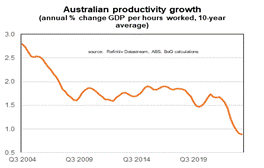
Australian productivity growth over the last 20 years
Productivity growth declined over the preceding decade.
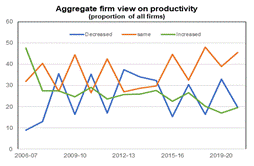
An aggregate view on productivity in Australian businesses from 2016 to 2020.
Over the last decade, less businesses have reported an increase in productivity.
Productivity across Australian industries and sectors
The industry with the lowest proportion of businesses experiencing productivity rises has typically been in logistics, with the highest proportion in utilities and manufacturing (manufacturing also typically has the highest proportion of businesses with declining productivity).
The differences between sectors as to the proportion of businesses experiencing increasing productivity is mostly modest. Health is where the largest proportion of firms typically experience unchanged productivity (it also has the smallest number of businesses experiencing productivity declines).
There have also been productivity cycles unique to some sectors. For example, there was a notable rise in the proportion of miners experiencing declining productivity during the investment phase of the mining boom. But there was not the same rise in the proportion of businesses experiencing increasing productivity once the investment had finished. There was also a notable rise in the proportion of retailers that experienced declining productivity last decade, a reflection of the weak consumer spending that characterised the 2010s.
What does this mean for Australia’s productivity growth?
Australian firms’ view of a decline in productivity growth over the past decade is consistent with the macro data. Secondly, larger businesses are more likely to experience productivity growth than their smaller- and medium-sized counterparts.
While governments and industry associations do have programs to help smaller firms improve productivity, further help may be required. Finally, productivity outcomes differ by industry. Some of that difference likely reflects sectors facing different cyclical challenges (such as mining and retail in the previous decade). In other sectors the challenges might be more structural.
We really do live in interesting times.
Regards,
Peter Munckton
BOQ Chief Economist.
You might also like
We're here to help.
NOT INVESTMENT RESEARCH
This presentation was prepared by Bank of Queensland Limited ABN 32 009 656 740 Australian Credit Licence Number 244616 (Bank).
No Reliance
This presentation is not investment research and does not purport to make any recommendations. This report is for informational purposes only and is not to be relied upon for investment purposes. You should seek independent advice from a qualified professional on these matters.
This presentation has been prepared without considering your objectives, financial situation, knowledge, experience or needs. The content of this presentation is not to be construed as an act of solicitation, or an offer to buy or sell financial products. To the extent that you choose to make any investment decision after having read this report, you should consider the appropriateness and suitability to your own objectives and obtain independent professional advice about your particular circumstances.
The Bank makes no representations or warranties about the accuracy or completeness of the content contained in this presentation. Any opinions, conclusions or recommendations made in this report are subject to change without notice, and may differ to the opinions, conclusions or recommendation expressed elsewhere by the Bank. The Bank is under no obligation to update, keep current, the information contained in the report.
Forward-Looking Statements
This presentation may contain forward-looking statements about market conditions. These forward-looking statements may be identified using forward-looking terminology, including the terms “believe”, “estimate”, “plan”, “target”, “project”, “anticipate”, “expect”, “intend”, “likely”, “may”, “will”, “could” or “should” or, in each case, their negative or other variations or other similar expressions, or by discussions of future events.
Readers should not place undue reliance on any forward-looking statements. To the maximum extent permitted by law, responsibility for the accuracy or completeness of any forward-looking statements, whether because of new information, future events, or results or otherwise, is disclaimed. BOQ does not undertake to update any forward-looking statements contained in this document, subject to disclosure requirements applicable to it.
Liability
The Bank does not accept any liability for any loss or damage arising out of any error or omission in the information provided or arising out of the use of all or any part of this presentation.